A city can lose fibre connections and still reach the internet through a satellite terminal. A government can buy that terminal and still lack authority over where, when or for which purpose its service operates. Both propositions can be true at once.
That tension is the central geopolitical issue in satellite connectivity. Starlink has made the subject visible; Russia’s Rassvet (Рассвет), developed by Bureau 1440, shows the attraction of building a domestic alternative. European and Chinese projects, together with Amazon’s network, broaden the contest. Yet a comparison based only on announced satellite numbers misses the most consequential question: who can keep the connection usable under pressure?
This column examines public evidence available on 18 October 2026, Japan time. Operator announcements establish what an organisation says it has launched or intends to deliver; they do not independently prove performance. Strategic implications and future scenarios below are SecOpsNomad analysis, not intelligence findings or predictions.
First, separate four different space capabilities
Satellite broadband transports information. Earth-observation satellites collect imagery or other sensor data. Navigation and timing systems support positioning and synchronisation. Missile-warning systems perform another specialised function. A communications network may carry data from these systems without itself providing all their capabilities.
The distinction also applies to products. SpaceX describes Starshield as a government offering, including communications and other national-security capabilities. It should not be used as an interchangeable name for every commercial Starlink subscription. Contract, terminal, authorisation and service features matter. SpaceX: Starshield
For this article, the focus is communications infrastructure and the decisions surrounding it. More connectivity can help transmit reports, coordinate logistics and maintain public services. It does not, by itself, establish accurate information, effective command decisions or military success.
The landscape: operating services and deployment programmes
The following is a maturity comparison, not a ranking of military effectiveness. Availability must still be checked for the actual location, customer and use case.
| Network | What the reviewed evidence establishes | What it does not establish |
|---|---|---|
| Starlink / SpaceX | Operating connectivity used in Ukraine and Japanese disaster response; access in Ukraine is subject to verification rules. | That every commercial plan permits every use, or that authorisation will remain unchanged. |
| Starshield / SpaceX | A government-focused offering; Ukrainian official reporting describes restrictions affecting some military use in October. | That commercial Starlink and a government service have identical controls, or who authorised each reported restriction. |
| Rassvet / Bureau 1440, Russia | The operator reports deployment milestones in March and July 2026. | Independently demonstrated global commercial coverage, wartime resilience or equivalence to Starlink. |
| OneWeb / Eutelsat | Eutelsat reports an operational LEO network, with ground coverage and commercial access developing by market. | A universally available, interchangeable replacement for an existing Starlink terminal. |
| IRIS² / European Union | A future European secure-connectivity programme with a revised architecture and launch timetable. | An operational IRIS² constellation available as a backup today. |
| Amazon Leo, formerly Project Kuiper | A network under deployment and a growing production programme. | That factory output equals spacecraft in service, or that a customer can already order service everywhere. |
| Qianfan / SpaceSail, China | Public authorities report continuing constellation launches in 2026. | Universally available service or independently validated performance in conflict. |
Sources for the operating examples and restrictions appear in the next section. For the other rows: Bureau 1440’s timeline, Eutelsat’s registration document, European Commission’s August update, Amazon’s renaming announcement, Amazon’s production report, and Shanghai’s September launch report.
Ukraine: access is an operational dependency
Ukraine’s Ministry of Defence explained in February 2026 that Starlink terminals in Ukraine require inclusion on an approved list. The policy demonstrates that possession of functioning hardware alone does not establish permission to connect. Ukrainian Ministry of Defence, 5 February 2026
On 14 October, ArmyInform, a Ukrainian Ministry of Defence publication, reported disrupted missions and connectivity restrictions affecting Starshield use, citing Ukrainian military personnel and an adviser. These are attributed Ukrainian reports, not an independent technical examination by this site. They do not settle responsibility for the decision, its rationale, contractual authority or its current scope. ArmyInform, 14 October 2026
The broader implication does not depend on guessing a political motive. An organisation can become deeply reliant on a service while the authority to change that service sits elsewhere. Procurement therefore needs to ask who may restrict access, how changes are communicated, which escalation routes exist and what the customer can still do during a dispute or outage.
This applies beyond armed forces. Civil authorities, hospitals, shipping companies and emergency responders can also become dependent on a commercially operated service. A contract covering ordinary conditions may leave important crisis assumptions untested.
Russia’s Rassvet: deployment is a milestone, not parity
Bureau 1440’s published timeline records 16 communications satellites entering orbit on 23 March 2026, followed by another launch milestone on 20 July. Its earlier test missions were called Rassvet 1 and Rassvet 2. The company also describes terminals and gateway stations as parts of its system. Bureau 1440
Those announcements support the conclusion that a Russian LEO broadband programme is progressing. They do not establish that the entire service chain has reached the coverage, capacity, manufacturing scale or operational maturity of an established network. No independently verified battlefield service assessment for Rassvet was established in this review.
Analysis: a domestically controlled network could reduce dependence on a foreign provider’s decisions. The burden then moves to domestic manufacturing, financing, launches, software operations and replacement capacity. National control can change who makes the decision to restrict service; it cannot abolish equipment failures or the costs of maintaining a constellation.
The right milestone to watch is usable service: terminals delivered, authorised customers connected, measured continuity, documented support and demonstrated recovery. A launch is necessary progress, but it answers only part of that question.
Europe, Amazon and China: alternatives with different clocks
Europe already has OneWeb. Eutelsat’s reporting describes an operational LEO network while also discussing the expansion of coverage, regulatory approvals and distribution. This is a useful reminder that satellites in orbit and service available to a particular buyer are separate milestones. Eutelsat registration document
IRIS² is a different proposition. The European Commission’s 7 August 2026 update describes a constellation of 330 higher-LEO and 18 medium-orbit satellites, with first launches in 2029 and early secure services afterwards. These are programme plans, not available capacity. European Commission
Amazon renamed Project Kuiper Amazon Leo in November 2025. Its October 2026 production report celebrates the 1,000th satellite built. That is a manufacturing milestone, not a claim that 1,000 spacecraft are providing commercial service. Amazon: naming, Amazon: manufacturing
China’s Qianfan programme is also deploying hardware. Shanghai’s government reported a September 2026 launch carrying eight networking satellites for Qianfan alongside an experimental satellite. This confirms a specific reported launch; it is not an audited measure of usable network capacity. Shanghai government, 22 September 2026
Analysis: more providers could improve bargaining power and resilience, but only if switching is practical. Different terminals, licences, integrators and operating conditions can make two constellations complementary without making them interchangeable. A future procurement promise cannot carry emergency traffic today.
A satellite connection still depends on the ground
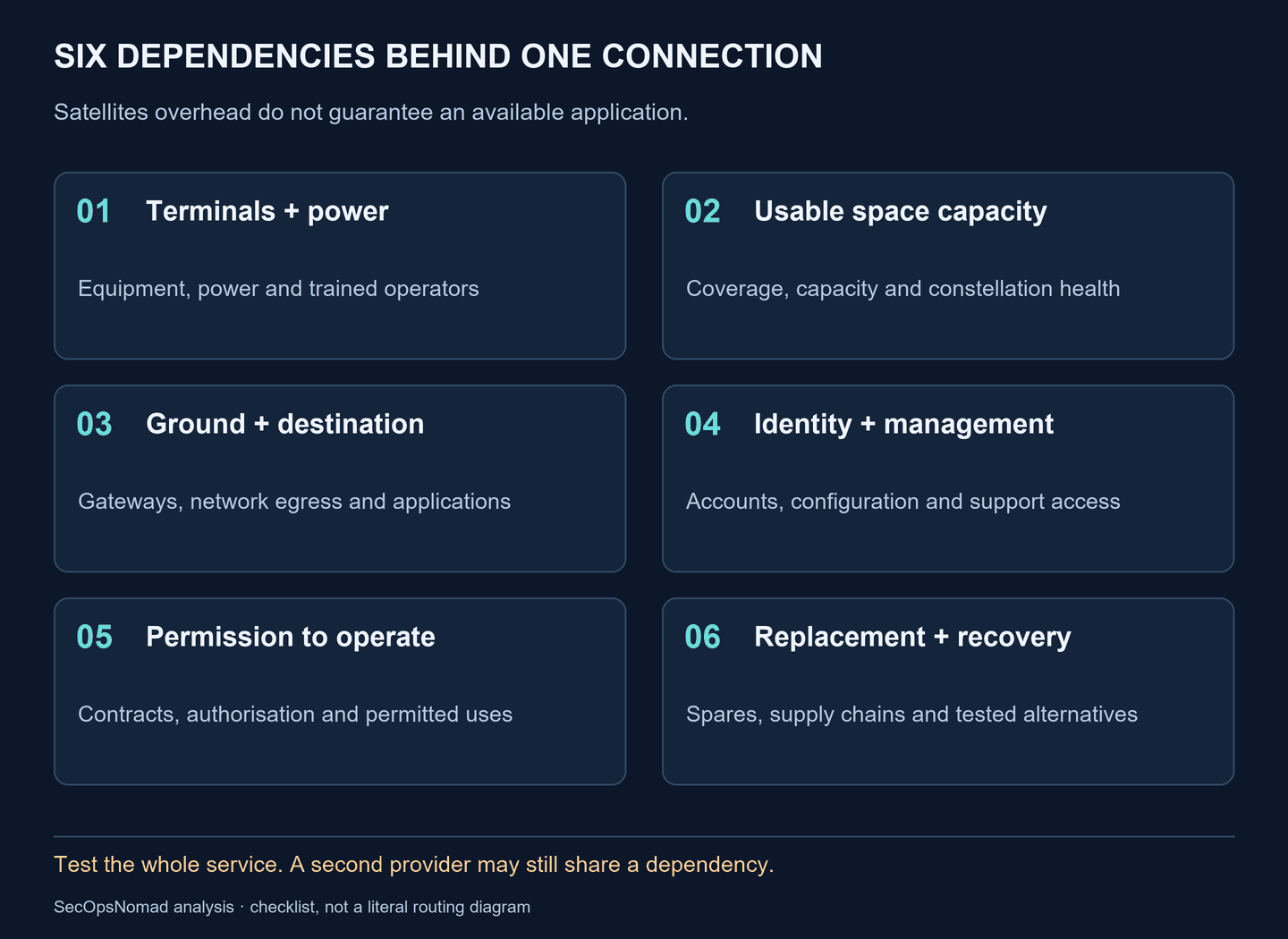
Figure 1. An analytical checklist, not a literal routing diagram. Individual systems implement these dependencies differently; inter-satellite links do not remove every ground or service dependency.
The 24 February 2022 KA-SAT incident provides a concrete cyber example. Viasat reported intrusion through a misconfigured VPN appliance into a trusted management network, followed by destructive management commands affecting customer modems. It reported no evidence that the satellite itself was compromised. Connectivity failed without an attacker needing to destroy a spacecraft. Viasat’s incident report, 30 March 2022
Several distinct mechanisms can produce a similar symptom—a terminal that cannot provide useful service:
| Failure mechanism | What a defender should establish | Why the distinction matters |
|---|---|---|
| Local equipment or power failure | Power condition, cabling, terminal health and a known-good replacement. | A provider change will not repair a shared failed power supply. |
| Radio interference or environmental impairment | Authorised measurements and provider assessment; avoid attribution from signal loss alone. | Credential resets do not address a radio-path problem. |
| Account or management compromise | Sign-in, privilege, configuration and administrative-action evidence. | Preserve evidence and contain access while arranging continuity. |
| Provider restriction or capacity limit | Service notices, contractual scope, entitlement and support confirmation. | A working terminal may be unable to obtain the required service. |
| Ground-network or destination failure | Reachability beyond the satellite hop, including DNS, identity and the application. | A healthy radio link does not prove an end-to-end business service. |
| Space-segment disruption | Provider-confirmed spacecraft or constellation impact and recovery estimates. | Do not infer sabotage or an actor from an outage alone. |
These categories are an assessment framework, not claims of vulnerabilities in every named provider. Encryption can protect data in transit, but it does not guarantee power, availability or authorisation. Conversely, an outage is not evidence that confidential data was stolen.
Japan: the civilian benefit is already tangible
On 7 January 2024, KDDI and Starlink Japan announced the delivery of 350 Starlink units to Ishikawa Prefecture for shelter connectivity after the Noto Peninsula earthquake. That is a concrete civilian use of satellite communications when terrestrial infrastructure is disrupted. KDDI’s announcement
For Japanese organisations, the practical lesson is to design continuity around essential services: contacting staff, coordinating supplies, reaching a remote facility or maintaining incident response. The same preparation can support different emergencies without assuming that disaster relief and wartime operations have identical permissions or risks.
Start by defining what must work. A low-bandwidth coordination channel may be more valuable than restoring every corporate application. Then check the whole path: power, equipment, trained staff, service entitlement, DNS, identity, VPN and the destination application. If the backup relies on the same unavailable identity tenant or support account, the second connection may add little resilience.
Satellite diversity also does not eliminate terrestrial dependence. This connects directly to our undersea-cables analysis: routes that look different can converge on shared facilities, providers or control systems.
Three futures to prepare for
The following are conditional planning scenarios through the early 2030s. They are not forecasts, assigned probabilities or assertions that conflict is inevitable.
1. Competition produces usable alternatives
If additional networks deliver service, compatible integration and reliable support, customers gain negotiating power and recovery options. The positive outcome is not merely a larger satellite population; it is the ability to move an essential workload to a genuinely separate service.
Watch: actual service acceptance, terminal availability, independent performance evidence and successful failover exercises. Prepare: keep configuration, documentation and staff training portable; avoid contracts that make an exit impractical.
2. Connectivity fragments along political boundaries
If governments and operators impose divergent access rules, customers may face a technically reachable network that they cannot lawfully or contractually use. Hardware ownership becomes less valuable than continuing authorisation and an enforceable support arrangement.
Watch: changes to service areas, permitted uses, licensing and crisis-management clauses. Prepare: review dependencies by jurisdiction with counsel and procurement; maintain approved alternatives before restrictions arrive. Do not treat bypassing provider controls as a continuity plan.
3. Different networks share the same weak dependency
If providers depend on common ground services, identity systems, integration partners or replenishment bottlenecks, nominal competition may hide correlated failures. Disruption could affect civilian users far from its original cause.
Watch: common subcontractors, authentication paths, maintenance channels and recovery constraints. Prepare: test failure of the shared dependency itself; keep a modest offline operating mode and a separate way to coordinate recovery.
Across all three scenarios, resilience depends on what an organisation can demonstrate under failure—not the nationality of a logo or the size of an announced constellation.
What each security team should do
These are general defensive recommendations, not evidence that your organisation or a named provider has been compromised.
| Owner | Action | Evidence to keep |
|---|---|---|
| IT Operations / continuity | Test one essential service over the alternative path, including loss of normal power and authentication where safe. | Measured recovery time, dependency diagram, equipment inventory and named operators. |
| Third-party Risk / procurement | Identify the operator, reseller, jurisdiction, change authority, supported uses and escalation route. | Service terms, support commitments and documented answers about shared dependencies. |
| SIEM / SOC | Correlate connectivity changes with account, configuration and endpoint events; monitor available administrative logs. | UTC timestamps, authorised change records and provider ticket references; buffer logs locally during outages. |
| Identity / EDR | Protect management accounts and support laptops; limit privileges and test emergency access under controlled conditions. | Access reviews, authentication controls, device coverage and tested recovery procedures. |
| Legal / Privacy | Review cross-border data handling, relevant permissions, crisis clauses and evidence-preservation obligations for the actual service. | Counsel-reviewed contract decisions and a contact matrix; do not infer jurisdiction from an overhead satellite. |
| Communications / incident lead | Separate confirmed impact, suspected mechanism and attribution. | A time-stamped situation report that states both known facts and unresolved questions. |
If evidence points to a stolen administration account, use the account-compromise playbook for detailed response decisions. Do not launch that process solely because a satellite connection dropped. This column supplies no campaign IOCs or hunting queries: the reviewed material does not establish a current, actionable indicator set for the networks compared here.
The question to take into the next exercise
Ask: “If this provider remains technically healthy but we lose permission, normal administration or access to its ground dependencies, which essential service can we still operate?”
A useful answer names an owner, an authorised alternative, a measured recovery time and evidence from a rehearsal. That is where the discussion moves from enthusiasm about space infrastructure to a defensible security posture.
Research boundaries and update triggers
This is an open-source comparative column. We did not inspect private contracts, run radio measurements, test terminals, validate classified capabilities or audit constellation health. We deliberately avoid live satellite-count rankings: launched, active, commissioned and commercially available are different categories.
Official statements can be authoritative about an organisation’s announcement while remaining interested accounts of performance. The Ukraine October report is attributed accordingly. Revisit this column when the restriction’s scope is clarified, Rassvet publishes verifiable service results, another network begins service in a relevant market, or IRIS² changes its delivery plan. Future scenarios should be revised with that evidence.