An identifier exposure and an operational outage
G-Plan’s G Point incident requires two separate assessments: what the exposed identifiers can reveal or enable, and whether the service can resume with customer points and exchanges correctly accounted for. The second question matters even if the exposed data does not directly identify a person.
G-Plan’s 30 September 2026 disclosure says it detected a system anomaly on 25 September, identified external unauthorized access and stopped the system that day. It reported possible exposure of up to approximately 70,000 member identifiers, with the cause and scope still under investigation. Related services also stopped. The notice said no additional unauthorized access had been detected at that point. These are company-reported findings, not an independent forensic assessment. G-Plan announcement
The 5 October article that prompted this analysis is later news coverage of that September disclosure. The date of detection is not necessarily the date the intrusion began. As of our source review on 5 October 2026, 14:01 JST, the official restart guidance still gave no reopening date. Official restart FAQ
What “member identifier” means here
The official FAQ describes the identifier as an internal code, such as an alphanumeric number, used to manage and distinguish customers. G-Plan says the identifier contains no name, address, telephone number or email address, and that an outside party cannot identify an individual from the identifier alone. This clarification should accompany the headline figure. Identifier FAQ
That does not establish that passwords, session tokens or gift-redemption codes leaked. The reviewed sources do not identify such an exposure. Nor does “70,000 identifiers” establish 70,000 account takeovers, a confirmed number of unique individuals, or an amount of stolen points.
The technical questions still requiring evidence are the identifier’s format and lifetime, where it is accepted, whether additional data was accessible, and whether any lookup or integration could link it to other records. These are investigation questions, not findings that G Point has such weaknesses. The reviewed notices do not disclose an entry method, exploited CVE, attacker, ransomware demand or incident-specific malicious IP, domain or hash.
Customer protection: the FAQs are more specific than the headline
The official service notice says points and G Point Gifts expiring during the suspension, and points in pending exchanges, will be protected from expiry or disappearance. Detailed handling is to be announced as reopening preparations progress. This is a stated customer-protection commitment; it does not itself demonstrate how every ledger entry has been reconciled. Service notice
The individual FAQs add distinctions worth keeping:
| Item | Official guidance at the review time |
|---|---|
| G Point balance | Held points will not disappear during the suspension; affected customers will be contacted when handling details are decided. Balance FAQ |
| G Point Gift | Gifts with an expiry from 25 September 2026 through one month after the service resumes are to have their expiry extended. The new expiry and procedure are not specified. Gift FAQ |
| Pending exchanges | The FAQ covers both incoming exchanges into G Point and applications to exchange out. Some partners’ procedures may be cancelled and points returned. Do not assume every request will complete unchanged. Exchange FAQ |
| G Point lottery | Redistribution is planned after reopening, with details to affected users later. Lottery FAQ |
| Marutoku investigator surveys / receipts | Handling of missed response or submission deadlines remains to be announced. Do not extend the point-expiry assurance to every benefit or campaign. Survey FAQ |
Customers should preserve exchange references, confirmation messages and available balance records, and use the official support route for discrepancies. Our recommendation is to avoid duplicate submissions unless the operator instructs otherwise. Treat unsolicited requests to “unlock,” “protect” or “restore” points as unverified: open the official site through a trusted route before acting. This is a preventive scenario, not a report of a confirmed phishing campaign linked to this incident.
What this changes for security posture
Identifiers need authorization boundaries, not just obscurity
In a well-designed system, knowing an object’s identifier should not grant permission to read or modify it. Each operation must enforce the caller’s access to the specific record and action. OWASP’s object-level authorization guidance makes clear that this applies to UUIDs as well as sequential numbers and other strings. Random identifiers can reduce guessability; they do not replace authorization. OWASP API1:2023
For operators of comparable services, review account lookup, point history, exchange requests, partner interfaces and support tooling using authorized test accounts in a controlled environment. Check both read and write permissions and privileged support exceptions. There is no published evidence here that broken object-level authorization caused G Point’s incident.
If an identifier is purely a reference, changing every identifier may break legitimate integrations without addressing the entry path. If evidence shows a value functions as an authentication secret, it requires a different containment plan. Determine its actual role before choosing a response.
Containment does not settle the integrity question
Blocking external access can contain a path while creating a business interruption. It does not, on its own, establish the integrity of stored records, remove persistence or prove every path is closed. Preserve the evidence behind the containment decision, check logging coverage, and document systems or integrations that remain reachable.
Likewise, an absence of alerts during a shutdown is not a complete test of safety after reopening. App and API telemetry, identity records, host evidence and integration controls must be assessed against the actual architecture. We do not infer which products or cloud provider G Point uses.
A points service must restore state across organizational boundaries
Our recovery recommendation is to reconcile each affected exchange across the customer-facing request, internal ledger, outbound instruction and partner acknowledgement. Decide which record is authoritative at each transition. Separate requested, reserved, submitted, accepted, completed, cancelled and reversed states according to the real business model; these labels are a reference model, not G Point’s disclosed implementation.
A timeout may occur after a partner has already accepted a request. Blindly replaying such work can create duplicates. Require a stable correlation reference, duplicate-safe processing, an explicit reversal policy and an exception queue for ambiguous outcomes. Reconcile amounts and directions within the same point type; do not add different programs’ point units or assume a one-to-one conversion.
Expiry protection needs similar care: freeze or adjust the relevant expiration jobs under change control, retain the pre-change evidence, record adjustments, and test the defined eligibility rules. The published commitment should translate into a verifiable customer outcome, rather than only a banner on the status page.
Which teams should act?
| Team | Priority | Evidence to request or retain |
|---|---|---|
| Incident lead / IT Operations | Establish containment and approved reopening gates | System inventory, reachable paths, corrective changes, logging health and rollback criteria |
| Application Security / IAM | Establish what the identifier permits | Data dictionary, authorization decisions, integration privileges and controlled access tests |
| SOC / SIEM | Connect access activity with application and transaction evidence | Resource IDs, request/operation IDs, authenticated principals, denied and successful actions, source time zones and collection gaps |
| EDR / DFIR | Investigate affected hosts when supported by evidence | Host/process timeline, persistence checks and preserved artifacts; do not infer employee-device compromise from the announcement |
| Fraud / ledger operations | Protect balances and resolve ambiguous exchanges | Before/after balances, journal entries, expiry adjustments, partner references and approved reversals |
| Third-party Risk / partner operations | Coordinate exchanges across systems | Named partner contacts, acceptance status, queue ownership, retry controls and written reconciliation decisions |
| Email Security / customer support | Handle possible impersonation and customer uncertainty | Original reported messages, a verified status page and support scripts that never use identifier knowledge alone as identity proof |
| Legal / Privacy | Assess the actual data and applicable obligations | Mapping/linkability assessment, awareness timeline, notification decisions and evidence-preservation instructions |
For partner organizations, a suspended connection is a dependency incident; it is not automatically evidence that the partner’s own environment was compromised. Determine whether your integration is actually affected and agree how queued or uncertain requests will be handled.
Reopening should follow evidence, not only a target date
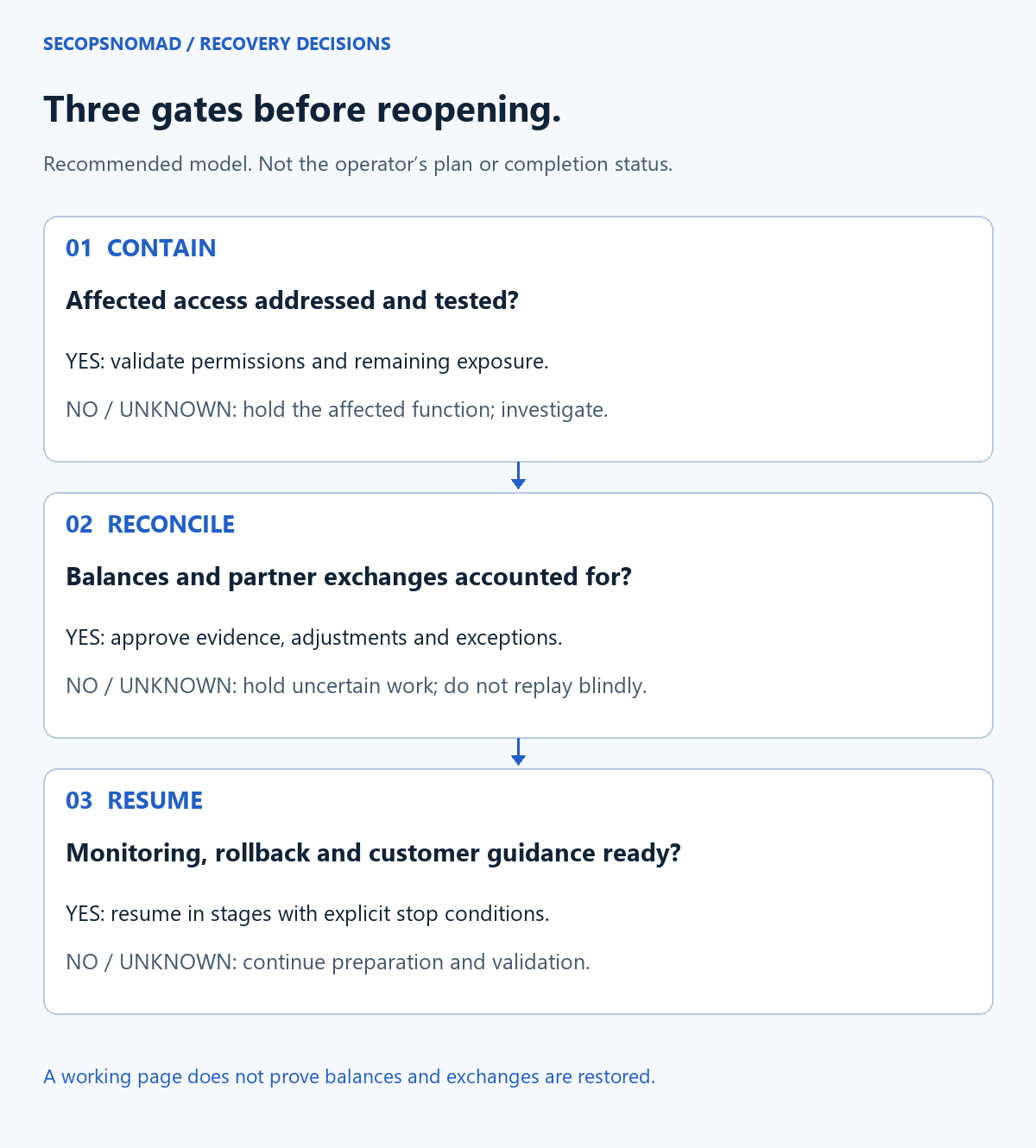
Original recommended recovery model. It does not describe G-Plan’s internal plan or certify that any gate has been completed.
| Decision | If yes | If no or unknown |
|---|---|---|
| Are the entry path and affected access addressed with supporting evidence? | Validate the relevant fix, credentials/sessions and remaining exposure | Keep the relevant containment measures and assign missing investigations |
| Can access to customer objects be verified against the caller’s permissions? | Complete controlled negative and positive authorization tests | Correct or investigate the boundary before exposing the affected function |
| Do balances, expiry adjustments and exchanges reconcile? | Have the business owner approve the reconciled scope and exceptions | Preserve discrepancies in an owned queue; do not silently repair or replay uncertain transfers |
| Do partners agree on completed, pending and cancelled work? | Use the agreed restart and duplicate-prevention plan | Keep ambiguous requests held and contact the counterpart through known channels |
| Are monitoring, rollback and customer instructions ready? | Resume in controlled stages with explicit stop conditions | Continue preparation; successful page loading is not a complete recovery test |
These checks can proceed in parallel with an incident timeline and clear owners. The organization may decide that limited functions can reopen before others; that decision should state its evidence, restrictions and residual uncertainty. The account-compromise playbook and phishing-response playbook apply when those specific workstreams are supported by evidence.
Hunting and reconciliation templates
There is no published IOC set in the sources reviewed. The following examples are read-only starting points for your own authorized environment. They do not query G Point and do not show that G Point uses Azure Monitor or Splunk. No real member identifier, credential or gift code is included.
KQL — Request outcomes around the detection date
Target: Azure Monitor / Log Analytics, using Application Insights data in AppRequests. This is not Defender XDR Advanced Hunting. Replace the exact resource and request-name placeholders, verify workspace permissions and retention, and choose a relevant endpoint in your own service. The example interval is 24 September 00:00 through 27 September 00:00 UTC, with an exclusive end. It surrounds the disclosed detection date; it is not an asserted attack window.
The query separates stored telemetry rows from the request volume represented by ItemCount. Sampling and missing instrumentation still limit interpretation. A success code does not prove authorized access or completed settlement, and a failure burst can reflect maintenance, retries or legitimate traffic. Correlate with authorization and business audit records. Microsoft table reference, Microsoft sampling-aware count example
Download the request-outcome query
// Azure Monitor / Log Analytics. Read-only; not live-tested.
// Example review window around detection, not a confirmed attack window.
let StartTime = datetime(2026-09-24T00:00:00Z);
let EndTime = datetime(2026-09-27T00:00:00Z);
let TargetResourceId = "REPLACE_WITH_EXACT_RESOURCE_ID";
let TargetRequestName = "REPLACE_WITH_EXACT_REQUEST_NAME";
AppRequests
| where TimeGenerated >= StartTime and TimeGenerated < EndTime
| where _ResourceId =~ TargetResourceId
| where Name == TargetRequestName
| summarize StoredRows = count(), RepresentedRequests = sum(ItemCount)
    by bin(TimeGenerated, 15m), ResultCode, Success
| order by TimeGenerated asc
| take 500
Splunk — Trace one exchange without assuming it completed
This is a custom business-audit template, not a vendor-provided sourcetype or G Point’s actual schema. Map app_id, tenant_id, exchange_id, partner_id, event_id, action, result, point_type, amount and direction to authorized audit data. Normalize the action names in the query and validate _time parsing before using the epoch bounds. Keep secrets and unnecessary member data out of search results.
The default interval matches the KQL example. For actual settlement reconciliation, extend it to the request’s creation and final resolution, include the relevant partner evidence and document gaps. Repeated audit entries are not automatically repeated transfers. Compare ledger effects and external acknowledgements before deduplicating or declaring a loss. Missing fields, filtered-out state names or logs outside the window can hide relevant activity. Splunk filtering reference
Download the exchange-trace query
index="REPLACE_WITH_AUDIT_INDEX" sourcetype="REPLACE_WITH_AUDIT_SOURCETYPE" earliest=1790208000 latest=1790467200
| where app_id="REPLACE_WITH_EXACT_APP_ID" AND tenant_id="REPLACE_WITH_EXACT_TENANT_ID"
| where exchange_id="REPLACE_WITH_REVIEWED_EXCHANGE_ID"
| where action IN ("requested", "reserved", "submitted", "accepted", "completed", "cancelled", "reversed", "expired")
| sort 500 + _time
| table _time app_id tenant_id exchange_id partner_id event_id action result point_type amount direction
Both templates cap output at 500 rows, not scan cost. Narrow time slices when the cap is reached and preserve the full relevant evidence separately. Execution status: schema/documentation review only; no live tenant execution. English, Japanese and downloadable query text match exactly.
Privacy, communication and what to watch next
Legal and privacy owners should assess the data as held in their organization, including available mappings and additional accessible records. The public term “member identifier” does not by itself settle legal classification or reporting duties. The PPC’s general guidelines provide the relevant framework; this article does not determine G-Plan’s legal obligations or compliance. PPC general guidelines
Customer communications should distinguish an unannounced restart date, a commitment to preserve value, and a completed individual exchange. Staff need consistent answers for each. Do not promise a compensation amount, a new gift expiry date or automatic completion where the operator has not announced it. Customers receiving an email about expiry handling can verify the same guidance through the official support pages before taking action.
The most decision-relevant updates would be a confirmed entry path, revised data scope, verified misuse, a restart plan, or a change to customer and partner handling. None should be inferred from the identifier count alone. Maintain separate status for confidentiality, availability and point-ledger integrity until the evidence supports closure.
5 October 2026 — First publication. Original bilingual analysis based on G-Plan’s September disclosure, current official FAQs and linked technical guidance. No leaked data or fabricated indicators are used.